
A tax advice service creates real business value when it improves decisions before money is committed, contracts are signed, or risk crystallises. Lodging a return correctly is important, but it is only one part of the value equation for Australian business owners, directors and high-net-worth individuals.
In our experience, the strongest tax outcomes come from integrating tax advice with bookkeeping quality, BAS and GST governance, payroll, Superannuation, entity structure, cash-flow forecasting and digital reporting. When those areas work together, tax stops being a year-end obligation and becomes a strategic lever for financial health.
For growing businesses across Adelaide, Sydney, Melbourne and broader Australia, the question is not simply, “Can someone prepare our tax return?” The more useful question is, “Can our tax advice help us make better commercial decisions with fewer surprises?”
What “real business value” means in tax advice
A value-adding tax advice service should change the quality, timing or confidence of a business decision. It should help identify what is deductible, what is risky, what needs restructuring and what should be planned months before lodgement.
That matters because Australian tax compliance is highly connected. A GST decision may affect BAS reporting. A payroll classification issue may affect PAYG withholding, Superannuation Guarantee and workers compensation. A director loan may have Division 7A implications. A property transaction may involve GST, capital gains tax, income tax and state-based duties.
The ATO increasingly uses data matching and digital reporting to identify inconsistencies across tax returns, BAS, Single Touch Payroll and third-party information. This does not mean every business is exposed, but it does mean fragmented accounting processes create unnecessary risk.
A strong adviser looks at the whole financial system. We want the tax position, accounts, governance and growth strategy to tell the same story.
Compliance is the starting point, not the destination
Tax compliance remains essential. Australian businesses must meet ATO lodgement deadlines, report GST accurately, maintain records, withhold PAYG where required and pay Superannuation correctly. For directors, the risk can become personal if obligations are ignored.
However, compliance alone rarely creates a competitive advantage. It protects the baseline. Real value begins when the tax advice service helps the owner or board make decisions such as:
- Whether to operate through a company, trust, partnership or group structure.
- How to fund expansion without creating avoidable tax leakage.
- Whether a proposed asset purchase should proceed before or after year-end.
- How to manage cash flow around BAS, PAYG instalments and payroll obligations.
- Whether a sale, restructure or succession plan requires earlier tax modelling.
For business owners reviewing their advisory arrangements, our perspective aligns closely with the broader principle that tax services should support business growth, not only annual reporting.
When a tax advice service adds measurable value
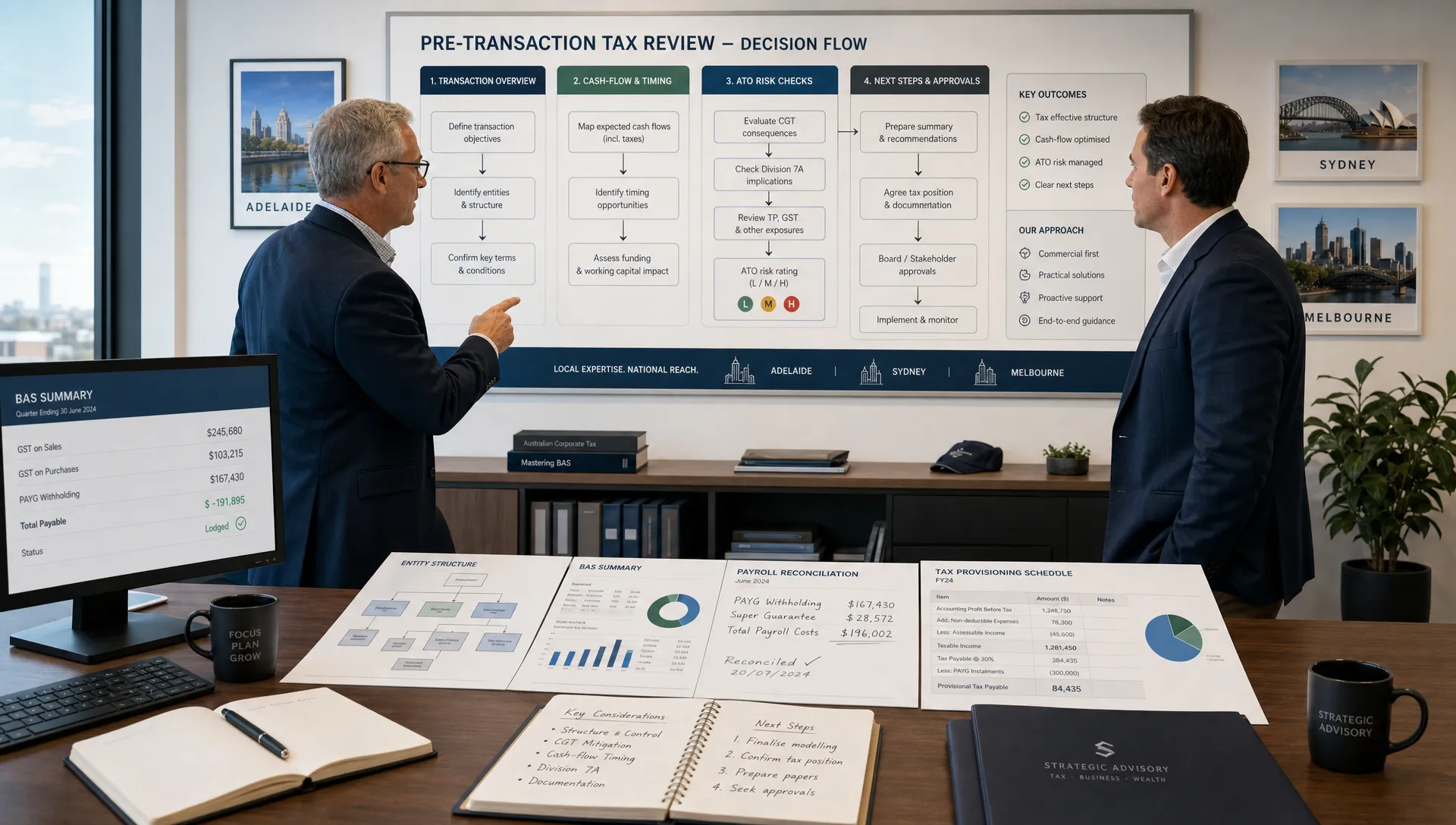
A tax adviser adds the most value when advice is sought before the transaction or business change occurs. Once a contract is signed, a distribution is made or a structure is implemented, the available options narrow.
The following scenarios are where we most often see tax advice move from compliance support to commercial advantage.
Business structure is limiting growth
Many businesses begin with a simple structure because it is quick and cost-effective. That may be suitable in the early stage, but it can become inefficient as profits grow, staff are hired, assets are acquired or risk increases.
A tax advice service adds value by reviewing whether the current structure still supports the owner’s objectives. This may involve asset protection, profit retention, family group planning, future sale readiness, Division 7A management or the separation of trading risk from investment assets.
The right answer is rarely generic. We consider tax, governance, commercial risk, administration cost and future exit options together.
Cash flow is being distorted by tax timing
Strong profits do not always mean strong cash flow. A business can look profitable while struggling with BAS payments, PAYG instalments, wages, supplier terms and debt repayments.
This is where tax advice becomes operational. We use accurate bookkeeping and real-time reporting to forecast obligations earlier. That helps directors plan for GST, income tax instalments, payroll tax where relevant, Superannuation and fringe benefits tax rather than reacting after the fact.
Modern tax advice should not leave the business owner surprised by a tax bill. It should build tax timing into the cash-flow rhythm of the business.
The business is scaling across locations or entities
Expansion across states, brands or entities adds complexity. A business operating in South Australia, Victoria and New South Wales may need coordinated advice across payroll, contractor arrangements, GST, land tax exposure, state taxes, inter-entity charges and management reporting.
Our national service model supports clients across Australia, with integrated capabilities in Adelaide, Sydney and Melbourne. That matters because multi-location businesses need one consistent advisory framework, not disconnected advice from separate sources.
Directors need better information for decisions
A director cannot make high-quality decisions from delayed or incomplete accounts. If management reports arrive too late, or if bookkeeping is not reconciled properly, tax advice becomes reactive.
A value-driven tax advice service improves the reliability of financial data. Clean accounts support better margin analysis, debtor management, expense control, tax planning and funding conversations.
This is why we see bookkeeping and compliance as the foundation for strategic advisory. When the underlying data is strong, the business can move from historical reporting to forward-looking planning.
| Situation | Basic tax support | Value-adding tax advice |
|---|---|---|
| Annual tax return | Prepares and lodges after year-end | Reviews structure, deductions, risks and future planning opportunities |
| BAS and GST | Reports figures from accounting software | Tests GST coding, cash-flow timing and transaction treatment |
| Payroll and Superannuation | Processes wages and reports STP | Reviews governance, classifications, SG exposure and timing obligations |
| Business growth | Records financial results | Models tax impact, funding needs and entity implications before expansion |
| ATO queries | Responds after an issue arises | Maintains documentation and identifies risk indicators earlier |
| Digital systems | Uses software for record keeping | Automates workflows for cleaner data and faster advisory insights |

The AI advantage in modern tax advisory
AI-driven automation does not replace professional judgement. It strengthens it by improving data quality, reducing manual processing and surfacing issues earlier.
In our accounting workflows, automation helps transform raw financial activity into structured advisory information. Bank feeds, invoice capture, coding rules, exception reporting and digital document management can reduce delays and inconsistencies. That gives our team more time to focus on interpretation, risk management and strategic planning.
For clients, the practical benefits are significant. They gain faster visibility over tax liabilities, clearer records for ATO substantiation and more timely insights into performance.
This is especially valuable for businesses with high transaction volumes, such as e-commerce operators, hospitality groups, construction firms, professional services firms, SaaS companies and property-related businesses. When the data is organised properly, tax planning becomes more precise.
Tax advice and ATO risk management
A strong tax advice service should help reduce avoidable ATO risk. This includes ensuring that claims are substantiated, GST is treated correctly, contractors and employees are classified appropriately, and related-party transactions are documented.
In Australia, tax agent services are regulated by the Tax Practitioners Board, and taxpayers should ensure they are working with properly registered advisers. The Tax Practitioners Board register is a practical reference point for checking registration.
Risk management is not about being conservative on every decision. It is about understanding the technical position, documenting the rationale and ensuring the business can support its claims if reviewed.
Common risk areas we review include:
- Private use adjustments for vehicles, travel, home office and mixed-purpose expenses.
- GST treatment on property transactions, exports, imports and complex supplies.
- Division 7A loans, unpaid present entitlements and related-party balances.
- Superannuation Guarantee, salary sacrifice and payroll reporting accuracy.
- Capital versus revenue treatment for asset purchases, repairs and development costs.
- Contractor arrangements, employee entitlements and FBT exposure.
Where matters are complex, specialist judgement becomes critical. We have discussed this in more depth in our article on what sets expert tax accountants apart in complex matters.
How to assess whether your tax advice is adding value
Business owners should assess tax advice with commercial metrics, not only lodgement completion. A return lodged on time is necessary, but it does not prove the advice improved the business.
We recommend reviewing your advisory relationship against four practical questions.
Did the advice arrive early enough to influence the decision?
Timing is often the difference between strategy and administration. If advice is received after a transaction, the adviser may only be able to report the outcome. If advice is received earlier, there may be better options around timing, structure, financing and documentation.
Did it connect tax with cash flow?
Tax advice should help management understand when cash will be required. This includes GST cycles, PAYG instalments, income tax, Superannuation, payroll tax where applicable and FBT obligations.
A technically correct tax position can still create operational stress if cash flow is not planned.
Did it improve governance?
For directors, governance matters. Records should support claims. Approvals should be documented. Related-party accounts should be monitored. Payroll settings should be checked. This reduces risk and improves the quality of board-level decisions.
Did it create forward visibility?
The most valuable advice gives the business a clearer view of the next quarter, next year and next major decision. This is where tax advisory overlaps with Virtual CFO support, forecasting and growth strategy.
If your adviser only speaks to you at lodgement time, there is likely untapped value in your finance function.
Where high-net-worth individuals need deeper advice
For high-net-worth individuals, the value of tax advice often sits in coordination. Personal tax, investment entities, trusts, companies, SMSFs, property portfolios and estate planning objectives can interact in ways that are not visible from a single tax return.
A tax advice service adds value by reviewing the whole position. This may include CGT planning, investment income, trust distributions, Division 7A, retirement strategy, philanthropic structures, foreign income, residency issues and family succession planning.
We do not treat these matters as isolated compliance tasks. We look at the commercial objective first, then align the tax and accounting framework around it.
The warning signs of low-value tax advice
Not every tax engagement delivers strategic value. Business owners and directors should be alert to warning signs, especially as their operations become more complex.
Low-value tax advice often has these characteristics:
- It focuses only on last year’s numbers, with no forward planning.
- It does not review BAS, GST, payroll, Superannuation or bookkeeping quality.
- It provides generic deduction lists without considering business structure or risk.
- It does not discuss cash-flow timing before major tax obligations arise.
- It avoids technology and relies heavily on manual document handling.
- It does not help management interpret financial performance.
By contrast, modern advisory should be proactive, data-informed and commercially grounded. We have explored the decision-making role of advisory in our article on how a business services accountant supports better decisions.
Frequently Asked Questions
When should we seek tax advice for a business decision? Ideally, before you commit to the transaction. Early advice gives us more room to assess structure, GST, CGT, cash flow, documentation and risk. Once the decision is implemented, the advice may be limited to reporting the outcome.
Is a tax advice service only useful for large companies? No. Sole traders, SMEs, family groups, property investors and high-net-worth individuals can all benefit from strategic tax advice. The key is complexity, risk and growth ambition, not only business size.
How does automation improve tax advice? Automation improves the quality and timeliness of financial data. Cleaner data allows our team to identify issues earlier, forecast obligations more accurately and provide advice based on current information rather than outdated records.
Can tax advice help with ATO audits or reviews? Yes. Strong advice can reduce risk before an audit and support the response if the ATO raises questions. Documentation, substantiation and consistent reporting across BAS, payroll and tax returns are critical.
What should directors expect from a modern tax adviser? Directors should expect technical competence, proactive planning, cash-flow visibility, governance support and clear communication. A modern adviser should connect tax with broader business strategy.
Next steps: turning tax advice into business value
If your tax advice is limited to annual lodgement, there may be significant value left on the table. The strongest outcomes come from integrating tax planning with accurate accounting, automated workflows, cash-flow forecasting and strategic advisory.
Our team at Perfect Accounting & Tax Services supports businesses, directors and high-net-worth individuals across Australia, with integrated service capabilities in Adelaide, Sydney and Melbourne. We combine 25 years of professional experience with AI-driven automation to help clients improve accuracy, speed and real-time financial visibility.
If you want a tax advice service that contributes to better decisions, stronger compliance and sustainable growth, contact our firm for a consultation. We can review your current accounting workflows, identify tax planning opportunities and show how automated financial systems can support a more strategic advisory model.