
Tax return services are often treated as a June or July activity: collect documents, calculate taxable income, lodge, then move on. For business owners, company directors, property investors, SMSF trustees, and high-net-worth individuals, that approach is usually too reactive.
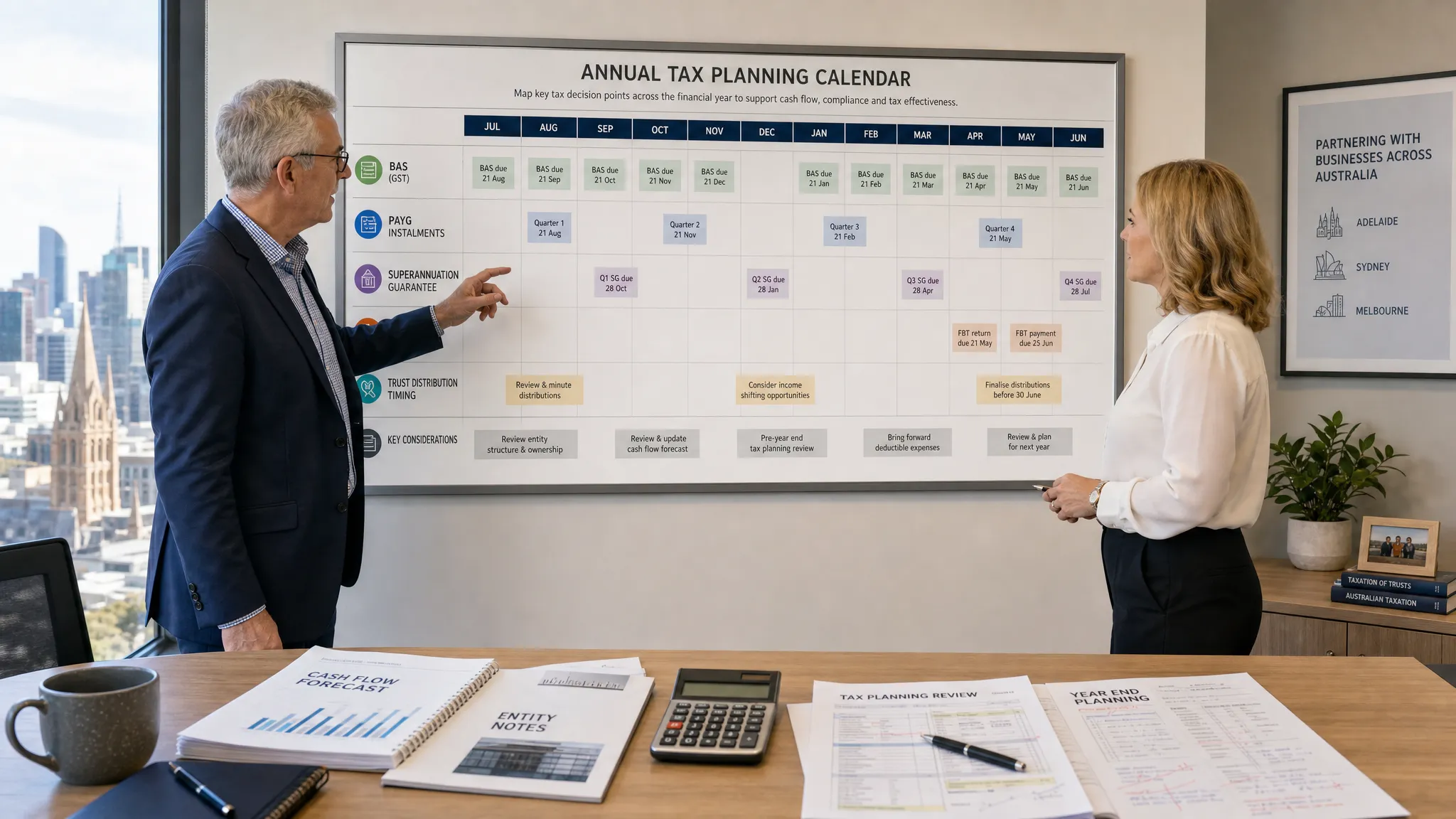
In Australia, the tax return is the final output of decisions made throughout the financial year. How income is recognised, how GST is reported, how payroll is managed, how assets are acquired, and how profit is distributed all shape the result long before lodgement. By the time tax time arrives, many opportunities to reduce risk, improve cash flow, and structure transactions efficiently have already passed.
We view year-round tax return services as a governance tool. Compliance still matters, but the larger value is strategic: cleaner financial data, earlier visibility of tax exposures, better planning for BAS and PAYG obligations, and stronger decision-making for growth.
Why tax time is too late for many taxpayers
For a simple salary earner with minimal deductions, annual lodgement through myTax may be sufficient. For anyone managing a business, investment portfolio, family group, trust, SMSF, or cross-border affairs, tax is not a once-a-year event.
The ATO receives data from banks, employers, superannuation funds, share registries, cryptocurrency platforms, government agencies, and other third parties. Business reporting also connects through Single Touch Payroll, BAS, GST, PAYG withholding, taxable payments annual reports, and superannuation systems. This makes consistency across the year essential.
If bookkeeping is inaccurate in September, BAS lodgements may be wrong in October. If payroll classifications are incorrect in January, superannuation and PAYG withholding issues may compound by June. If a business sale or property transaction is signed before tax advice is obtained, the tax outcome may be largely locked in.
The ATO also expects taxpayers to keep proper records. Its business record-keeping guidance makes clear that records must explain transactions and support tax positions. Year-round systems make that practical. Last-minute reconstruction creates risk.
Who needs tax return services beyond tax time?
Not every taxpayer needs the same level of support. The question is not simply whether you need someone to lodge a return. The better question is whether your financial decisions during the year create tax consequences that should be monitored before lodgement.
Business owners and company directors
Company directors need year-round tax support because business tax obligations run continuously. Income tax is only one part of the picture. Directors also need to manage BAS, GST, PAYG withholding, superannuation, payroll tax exposure where relevant, FBT, director loans, dividends, trust distributions, and cash flow planning.
A June meeting cannot fix every issue created by poor monthly reporting. For example, GST coding errors may distort BAS lodgements, private expenses may be incorrectly claimed, and director drawings may create Division 7A concerns if not reviewed early.
For directors, tax return services should connect compliance with commercial decisions. We use tax work as a foundation for forecasting, debt planning, margin review, and corporate growth strategy. This is where a tax professional moves from being a lodgement provider to becoming part of the management discipline of the business, a topic we explore further in our article on when a tax professional becomes a strategic advantage.
Sole traders, contractors, and professional consultants
Sole traders and consultants often have fluctuating income, mixed-use expenses, home office claims, motor vehicle costs, subscriptions, software, subcontractors, and irregular cash flow. Many also move quickly from small side income to a level where GST registration, PAYG instalments, and more formal record-keeping become necessary.
Once business income becomes material, tax planning should happen during the year. Waiting until lodgement may lead to unexpected tax bills, missed GST registration timing, weak evidence for deductions, and poor separation between personal and business spending.
For professionals such as IT consultants, designers, allied health practitioners, real estate agents, architects, lawyers in private practice, and marketing agency owners, year-round support helps align tax compliance with pricing, cash reserves, and growth decisions.
Employers with payroll, superannuation, and FBT obligations
Any business with employees should treat tax as an operating system, not an annual task. Payroll creates continuous obligations through PAYG withholding, STP reporting, superannuation guarantee, workers compensation, leave entitlements, and potentially payroll tax.
FBT is another area where timing matters. The FBT year runs from 1 April to 31 March, not 1 July to 30 June. Vehicles, entertainment, car parking, employee benefits, salary packaging, and private use of business assets should be reviewed before the FBT year closes.
The risk is not only additional tax. Poor payroll governance can affect employee trust, director exposure, and due diligence outcomes if the business seeks finance, investment, or sale.
Property investors, developers, and landlords
Property tax outcomes are often determined before contracts are signed. Residential investors, commercial landlords, property developers, foreign investors, and property syndicates all benefit from early advice.
Key issues may include interest deductibility, loan purpose, repairs versus capital improvements, depreciation, GST on commercial property, margin scheme considerations, land tax coordination, trust ownership, CGT timing, and cash flow forecasting.
A first-time residential investor may need support to correctly capture rental income and deductions. A commercial landlord may need GST and lease treatment reviewed. A developer may require deeper analysis around trading stock, financing, GST, entity structure, and project reporting.
Tax return services beyond tax time help ensure the transaction record is built correctly from the beginning, rather than reconstructed after settlement.
High-net-worth individuals and family groups
High-net-worth individuals often have multiple income streams: investment portfolios, trusts, companies, property, foreign income, managed funds, capital gains, employee share schemes, private business interests, and philanthropic structures.
For these taxpayers, annual lodgement is a consolidation exercise. The real work is managing tax positions progressively. Trust distribution resolutions, company dividends, CGT events, investment timing, and asset protection considerations need attention before year-end.
Family groups also require consistency across entities. A deduction in one entity may correspond to income in another. A trust distribution may affect an individual return. A company loan may create downstream tax implications. Year-round oversight helps keep the group position coherent.
SMSF trustees and retirement-focused investors
SMSF trustees need ongoing tax and compliance discipline. Investment decisions, contribution caps, pension payments, related party transactions, limited recourse borrowing arrangements, and asset valuations can all affect the fund’s tax and regulatory position.
SMSF tax return services should not be separated from governance. Trustees need evidence, timing, and documentation. Waiting until annual accounts are prepared may expose problems that could have been managed earlier.
Late filers and taxpayers facing ATO scrutiny
Late tax filers often need more than lodgement. They need a structured recovery plan. That may include reconstructing records, prioritising outstanding returns, reviewing BAS history, communicating with the ATO, addressing penalties or interest, and building a process to prevent recurrence.
Business owners facing an audit, review, or ATO query should also seek support beyond tax time. The focus shifts from preparation to evidence, consistency, and risk management. Clean digital records, clear reconciliations, and timely responses matter.
Common year-round tax triggers by taxpayer type
| Taxpayer profile | Why tax time is too late | Year-round focus |
|---|---|---|
| Company directors | BAS, GST, payroll, dividends, loans, and cash flow decisions occur throughout the year | Monthly reporting, PAYG planning, GST accuracy, director loan review |
| Sole traders and consultants | Income can fluctuate and deductions require evidence | GST registration, expense substantiation, PAYG instalment planning |
| Employers | Payroll, superannuation, STP, and FBT obligations are continuous | Payroll governance, superannuation review, FBT tracking |
| Property investors | Tax treatment is shaped by purchase structure, finance, and asset use | Loan purpose, CGT planning, GST, depreciation records |
| High-net-worth families | Multiple entities and income sources interact | Trust distributions, investment reporting, CGT, family group coordination |
| SMSF trustees | Compliance depends on trustee decisions during the year | Contributions, pensions, asset valuations, investment evidence |
| Late filers | Historical issues can compound quickly | Lodgement catch-up, ATO communication, digital record rebuilding |
What year-round tax return services should include
A modern tax relationship should go well beyond collecting receipts in June. We believe effective year-round tax support should include several connected disciplines.
Digital record architecture
Accurate tax returns begin with accurate data. We help clients structure bookkeeping workflows so transactions are coded correctly, source documents are captured, and reconciliations are completed regularly. This creates a stronger evidence base for deductions, GST claims, payroll reporting, and management decisions.
Automation is important here. Our AI-driven processes help streamline document capture, classification, review workflows, and exception identification. The objective is not to remove professional judgement. It is to free our team to focus on analysis, anomalies, and strategic advice rather than manual data handling.
BAS, GST, and PAYG monitoring
BAS lodgement should not be treated as a clerical task. It affects cash flow, pricing, debt planning, and compliance history. The ATO publishes BAS lodgement and payment due dates, but meeting deadlines is only the baseline.
Businesses should also monitor GST coding, input tax credit claims, export income, private apportionment, hire purchase treatment, and timing differences. PAYG instalments should be reviewed against expected profitability so tax cash reserves remain realistic.
Tax planning before key decisions
Tax planning has the greatest value before a transaction occurs. Selling a business, buying a property, hiring senior staff, issuing shares, restructuring debt, moving interstate, expanding into Sydney or Melbourne from Adelaide, or introducing investors can all change the tax profile.
A pre-lodgement discussion still has value, but it should not be the only planning point. We recommend using structured check-ins during the year, particularly before major commercial decisions. Our guide on what to cover in a tax consultation before you lodge outlines the types of issues that should be reviewed before final lodgement.

Management reporting and strategic advisory
Tax data should also inform strategy. When accounts are maintained in real time, management can see margins, debtor trends, GST liabilities, wage costs, tax reserves, and profit movements earlier.
This is where compliance becomes a strategic asset. A business owner can decide whether to hire, finance equipment, defer a purchase, distribute profits, repay debt, or retain cash with more confidence. For growing businesses, virtual CFO support can connect tax planning with budgets, forecasts, board reporting, and expansion strategy.
If you are assessing providers, our article on how to choose tax services that support business growth sets out the capabilities to look for beyond basic lodgement.
Strategic moments when you should seek tax support before year-end
Some events should trigger immediate tax advice, even if tax time is months away.
Seek advice early if you are selling or buying a business, acquiring property, changing entity structure, issuing equity, expanding interstate, hiring employees, providing vehicles or benefits, receiving foreign income, dealing with cryptocurrency, catching up on overdue returns, applying for finance, preparing for sale, or facing an ATO review.
The same applies if profit is materially higher or lower than expected. Tax instalments, dividend planning, trust distributions, and cash reserves may need adjustment. A growing business can still experience tax stress if planning lags behind performance.
How automation improves tax return services beyond tax time
Traditional accounting often relies on historical data. By the time reports are prepared, the opportunity to act may have passed. Digital transformation changes that rhythm.
With automated workflows, bank feeds, document capture, rule-based processing, and AI-supported exception review, our team can identify inconsistencies earlier. This improves accuracy and gives clients more current financial visibility.
For example, automation can help surface unusual expense coding, missing supplier documents, inconsistent GST treatment, payroll anomalies, or changes in gross margin. Professional review remains essential, but the technology improves speed and focus.
For clients operating across Adelaide, Sydney, Melbourne, and other parts of Australia, integrated digital workflows also create consistency. Directors and management teams can work from a single financial picture rather than relying on fragmented local processes.
Practical next steps before tax time arrives
If your tax affairs are more complex than a simple salary return, we recommend taking action before the financial year closes.
- Review your year-to-date profit position: Compare actual performance with expected taxable income, PAYG instalments, and cash reserves.
- Check BAS and GST accuracy: Confirm GST coding, reconciliations, private apportionment, and any unusual transactions.
- Review payroll and superannuation obligations: Ensure STP, PAYG withholding, superannuation, and contractor classifications are clean.
- Assess upcoming transactions: Obtain advice before asset sales, restructuring, property purchases, dividends, trust distributions, or finance applications.
- Upgrade record-keeping workflows: Move away from manual, delayed, or incomplete records and build an automated workflow with proper review controls.
- Book a strategic tax consultation: Use the meeting to review compliance, cash flow, risk, and growth planning together.
Frequently Asked Questions
Do I need tax return services all year if my accountant lodges my return annually? If your affairs are simple, annual support may be enough. If you operate a business, hold investment property, manage employees, use a trust or company, run an SMSF, or have variable income, year-round support usually provides better control and fewer surprises.
Is year-round tax support only for large companies? No. Many sole traders, consultants, tradies, e-commerce operators, property investors, and family businesses benefit from regular tax oversight. Complexity, not size alone, determines the need.
Can tax planning reduce my ATO risk? Good planning can reduce risk by improving records, aligning BAS and income tax positions, documenting deductions, and identifying issues before lodgement. It should always operate within Australian tax law and ATO guidance.
How does automation improve tax return services? Automation helps capture documents, process transactions, flag anomalies, and keep records current. Our team then applies professional judgement to interpret the data, review tax positions, and provide strategic advice.
When should I contact a tax adviser before tax time? Contact us before major transactions, business growth decisions, hiring, restructuring, property purchases, trust distributions, SMSF decisions, overseas moves, or if you receive ATO correspondence.
How we can help
Our team provides tax return services, accounting, BAS, payroll, SMSF support, virtual CFO advisory, and strategic tax planning for clients across Australia. With integrated capabilities in Adelaide, Sydney, and Melbourne, we support local SMEs, national businesses, company directors, investors, and high-net-worth individuals with practical, compliant, technology-enabled advice.
We combine 25 years of professional experience with AI-driven automation to improve accuracy, speed, and real-time financial visibility. Our objective is not simply to lodge tax returns. It is to help clients build stronger financial systems, reduce compliance friction, and make better strategic decisions throughout the year.
If tax time has become a recurring source of pressure, the issue may not be the return itself. It may be the absence of a year-round tax workflow.
Contact Perfect Accounting & Tax Services to arrange a consultation and learn how our automated accounting workflows can support your compliance, cash flow, and long-term growth.
This article provides general information only and does not constitute personal tax advice. We recommend obtaining advice tailored to your circumstances before making tax or business decisions.