
Many Australian businesses first engage an accountant because something must be lodged: an income tax return, a BAS, payroll reporting, a company return, a trust distribution resolution, or a response to an ATO letter. That is understandable. Compliance deadlines are visible, penalties are real, and directors need confidence that obligations are being met.
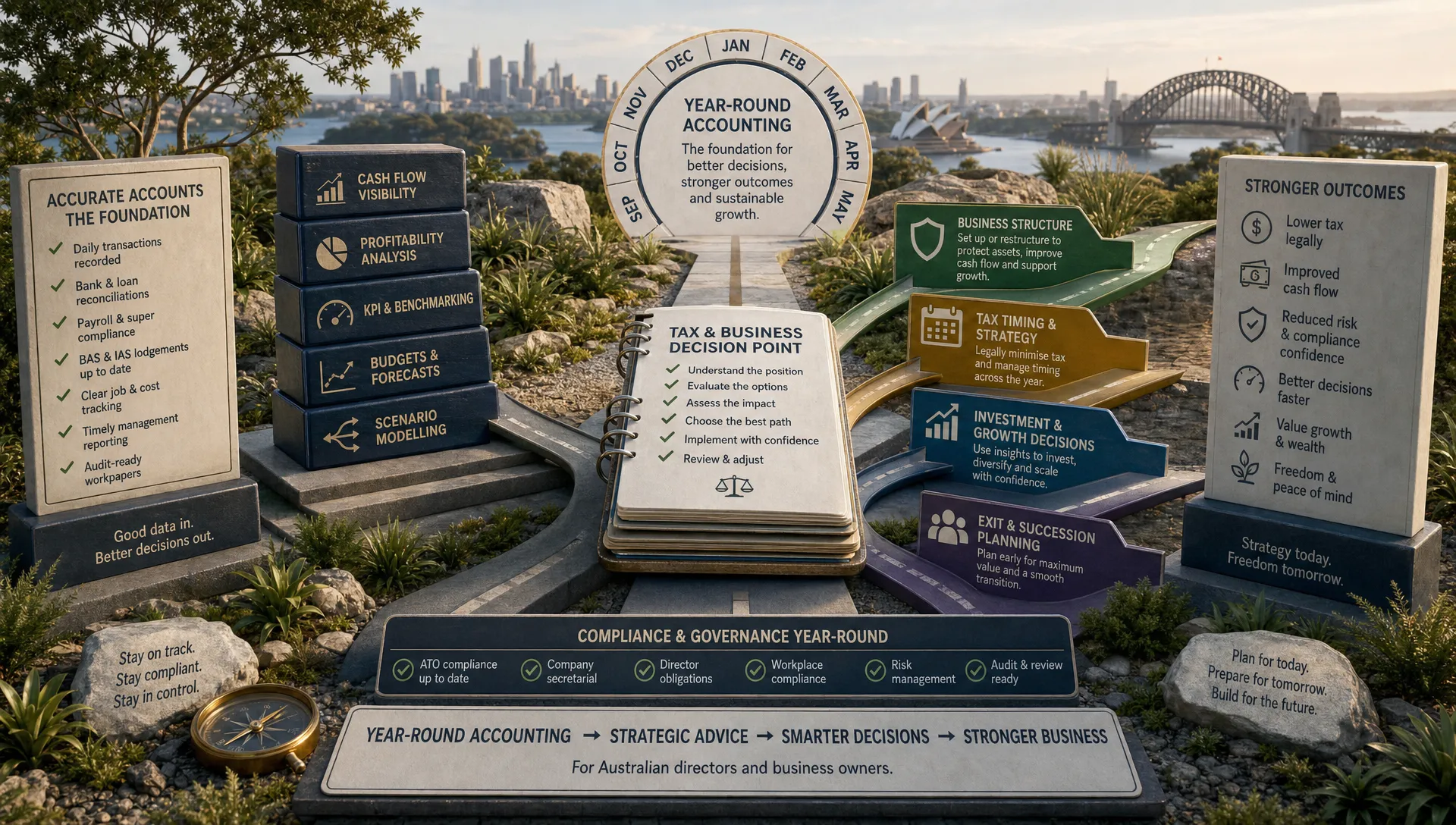
But professional accounting services should do more than keep a business out of trouble. For company directors, business owners, property investors and high-net-worth individuals, accounting should become a decision system. It should clarify profitability, cash flow, tax exposure, capital requirements, business structure and growth options.
We see compliance as the foundation. The real value begins when accurate financial data is converted into strategic advisory, better governance and faster commercial decisions.
Compliance is the floor, not the ceiling
Australian compliance is not simple. A growing business may need to manage GST, BAS, PAYG withholding, Single Touch Payroll, Superannuation Guarantee, FBT, TFN declarations, contractor reporting, payroll tax exposure, income tax instalments and company secretarial requirements. SMSF trustees, property investors and family groups face further layers of reporting and substantiation.
The ATO expects businesses to keep adequate records, and it generally requires those records to be retained for five years. Its record-keeping guidance makes clear that records must explain transactions, support tax positions and be accessible when required.
That matters. Strong compliance reduces audit disruption, late lodgement risk, interest charges, director stress and unnecessary ATO scrutiny. However, a compliance-only relationship often answers questions too late. It tells you what happened last year rather than what needs to change next quarter.
When professional accounting services are delivered strategically, compliance becomes the baseline data layer for planning.
What changes when accounting becomes strategic
The difference is not merely technical skill. It is the way financial information is structured, interpreted and used. A professional accounting team should help you see the business clearly enough to act before problems become expensive.
Better financial control
A company can be profitable on paper and still run out of cash. It can have growing revenue while margins are quietly falling. It can lodge every BAS on time while directors remain uncertain about debtor quality, inventory levels, job profitability or payroll leakage.
We focus on financial control because it is the bridge between compliance and growth. This includes a clean chart of accounts, disciplined reconciliations, GST coding checks, payroll review, debtor monitoring, cost centre reporting and management accounts that directors can trust.
If financial reports arrive late, contain miscoded transactions or require constant manual correction, the business is not truly in control. We have explored this in more depth in our article on how accounting professionals can improve financial control, particularly for growing Australian businesses that need reliable data before making larger decisions.
Cash-flow visibility
Tax compliance and cash-flow planning are closely connected. BAS liabilities, PAYG instalments, superannuation payments, FBT instalments, supplier terms and debtors all affect working capital.
A strategic accountant does not simply lodge the BAS. We assess whether GST obligations are being forecast correctly, whether PAYG instalments reflect current profit, whether tax reserves are adequate and whether the business has enough liquidity to fund expansion without creating stress.
This is particularly important for construction firms, professional practices, e-commerce operators, medical groups, manufacturers and property businesses. These sectors often deal with timing differences between revenue recognition, cash collection, supplier payments and tax liabilities.
Tax planning before the transaction
The most valuable tax advice is usually given before a transaction occurs. Once a contract is signed, a property is sold, a dividend is declared, a trust distribution is made, or a major asset is purchased, many options are already limited.
Professional accounting services should consider structure, timing, deductibility, GST treatment, CGT exposure, Division 7A, trust distributions, FBT implications, payroll tax risk and asset protection in context. The goal is not aggressive tax minimisation. The goal is a commercially sound, properly documented position that aligns with Australian tax law and the client’s long-term objectives.
For complex situations, a tax professional becomes a strategic partner rather than a year-end processor. We have written separately about when a tax professional becomes a strategic advantage for business owners dealing with structure, risk and growth.
Stronger director governance
Company directors have legal duties. ASIC explains that company officeholders must act with care and diligence, act in the company’s best interests and prevent insolvent trading, among other obligations. Its company officeholder duties guidance reinforces why directors need accurate and timely financial information.
Good accounting supports those duties. Directors should not be making decisions from stale management accounts, incomplete payroll data or unverified cash-flow assumptions. They need financial reporting that helps them identify risk early and document decisions properly.
| Compliance-only accounting | Strategic professional accounting services |
|---|---|
| Annual accounts prepared after year-end | Regular management reporting that supports decisions during the year |
| BAS lodged as an administrative task | BAS used to forecast GST, PAYG and cash-flow pressure |
| Payroll processed without deeper review | Payroll, Superannuation Guarantee, STP and FBT risks monitored together |
| Tax return focused on historical results | Tax planning aligned with structure, investment and profit forecasts |
| Records stored for lodgement purposes | Audit-ready documentation that supports governance and funding discussions |
| Accountant engaged when deadlines arise | Adviser involved before major transactions, expansion or restructuring |

Digital accounting turns data into real-time insight
Modern professional accounting services should be technology-enabled. Manual bookkeeping and spreadsheet-heavy workflows are too slow for businesses that need visibility across multiple locations, entities or revenue streams.
Our team uses AI-driven automation to streamline accounting workflows, reduce repetitive processing and improve the accuracy of financial information. That may include automated document capture, bank transaction matching, exception review, GST coding checks and faster preparation of management reports.
Technology does not replace professional judgement. It strengthens it. Automation helps identify anomalies faster, but experienced advisers still need to interpret the commercial meaning. For example, an automated workflow may flag a sharp increase in subcontractor costs. A strategic accounting review then asks whether margins have changed, whether payroll tax exposure has increased, whether contractor arrangements are properly documented and whether pricing needs adjustment.
This is where accounting becomes forward-looking. Instead of waiting for the end of the financial year, directors can review performance trends, tax exposure and working capital needs while there is still time to act.
Why it matters for different Australian business and investment profiles
The value of professional accounting services differs depending on the client’s structure, sector and objectives. A sole trader with expanding turnover needs different support from a family group holding commercial property, and a SaaS founder preparing for investment needs different insight from a medical specialist managing service entity arrangements.
| Client profile | Strategic accounting focus |
|---|---|
| Company directors | Management reporting, cash-flow forecasting, tax planning, governance and director risk |
| Property investors and developers | GST treatment, CGT planning, financing structure, entity selection and documentation |
| SMSF trustees | Compliance, investment documentation, contribution planning and audit readiness |
| E-commerce and SaaS businesses | Revenue recognition, GST, international transactions, inventory or subscription metrics |
| Construction and trade businesses | Job costing, progress claims, retention amounts, subcontractor controls and cash-flow timing |
| Professional practices | Service entity arrangements, payroll, FBT, profit distributions and practice performance |
| High-net-worth individuals | Family group reporting, investment income, trust planning, asset protection and tax governance |
The common theme is clarity. Strategic accounting helps owners understand where value is being created, where risk is accumulating and which decisions should be made before the next tax deadline.
Professional accounting services create better growth decisions
Growth often exposes weak accounting systems. A business that feels manageable at $1 million in turnover may become far more complex at $5 million. More staff, more suppliers, more debtors, more tax obligations and more entities can quickly overwhelm basic processes.
Before expanding into another state, hiring senior staff, purchasing equipment, opening a second location, raising capital, acquiring a competitor or restructuring a family group, directors need clean numbers. They also need modelling that tests the impact on tax, cash flow, finance covenants and working capital.
This is why we connect compliance work to Virtual CFO support and strategic advisory. The monthly accounts should not be a static report. They should inform pricing, staffing, stock levels, debt management, tax reserves and capital allocation.
For clients operating across Adelaide, Sydney and Melbourne, this integrated approach is especially important. Different state-based issues, such as payroll tax, land tax and industry licensing requirements, can interact with federal tax obligations. A national accounting view helps reduce fragmentation and improves consistency across the business.
How to assess whether your accountant is adding strategic value
A business owner does not need more reports for the sake of reporting. The issue is whether the accounting function helps management make better decisions.
Useful questions include:
- Are management accounts delivered early enough to influence decisions?
- Does the accounting team explain the tax and cash-flow impact of planned transactions?
- Are GST, payroll, Superannuation Guarantee and FBT reviewed as connected risks?
- Is technology reducing manual processing and improving real-time visibility?
- Does the advice consider structure, asset protection, financing and growth objectives?
- Are directors receiving clear commentary, not just financial statements?
If the answer is no, the business may be receiving compliance support but not the full benefit of professional accounting services. Our guide on how to choose tax services that support business growth outlines what growing businesses should look for when advice needs to extend beyond lodgement.
Why this is especially important in 2026
Australian businesses are operating in an environment of higher data visibility, increased automation and ongoing regulatory scrutiny. The ATO’s use of data matching, digital reporting and cross-agency information has made poor records easier to identify. At the same time, directors need faster insight as margins, wages, rent, interest costs and supply chain pressures continue to affect profitability.
In this environment, delayed accounting is a risk. If a director only understands profitability after the financial year has ended, the opportunity to correct pricing, manage tax reserves or restructure operations may already be lost.
Professional accounting services should therefore operate as part of the management rhythm of the business. Compliance remains essential, but the higher value lies in using compliant data to support commercial judgement.
Frequently Asked Questions
What are professional accounting services? Professional accounting services include tax compliance, BAS, bookkeeping, payroll, financial reporting, management accounts, tax planning, business structuring and strategic advisory. For growing Australian businesses, the most valuable services connect compliance with decision-making.
How are professional accounting services different from basic bookkeeping? Bookkeeping records transactions. Professional accounting services interpret those records, test their accuracy, manage compliance risk and help directors make decisions about tax, cash flow, profit, structure and growth.
When should a business move beyond compliance-only accounting? A business should move beyond compliance-only accounting when it has staff, GST obligations, multiple entities, external finance, property investments, interstate operations, rapid growth, cash-flow pressure, or directors who need clearer financial reporting.
Can AI replace an accountant? No. AI can automate repetitive tasks, identify exceptions and accelerate reporting, but professional judgement remains essential. Australian tax law, governance, structuring and strategic advisory require interpretation, context and experience.
Do high-net-worth individuals also need strategic accounting? Yes. High-net-worth individuals often manage trusts, companies, SMSFs, investment properties, private business interests and family wealth structures. Strategic accounting helps coordinate tax, documentation, cash flow, risk and succession considerations.
Next steps: turn compliance into a strategic asset
If your accounting support is limited to annual tax returns and deadline management, you may be missing the larger opportunity. Accurate compliance should be the starting point for stronger financial control, proactive tax planning and better commercial decisions.
Our team at Perfect Accounting & Tax Services supports businesses, directors and high-net-worth individuals across Australia, with integrated capabilities in Adelaide, Sydney and Melbourne. With 25 years of professional experience, we combine technical accounting expertise with AI-driven automation to improve accuracy, speed and real-time financial visibility.
We can help you review your current accounting workflow, strengthen BAS and payroll processes, improve management reporting, assess tax planning opportunities and build an advisory framework that supports corporate growth.
To discuss how professional accounting services can support your next stage of growth, contact Perfect Accounting & Tax Services for a consultation and learn how our automated accounting workflows can give you clearer, faster and more strategic financial insight.