
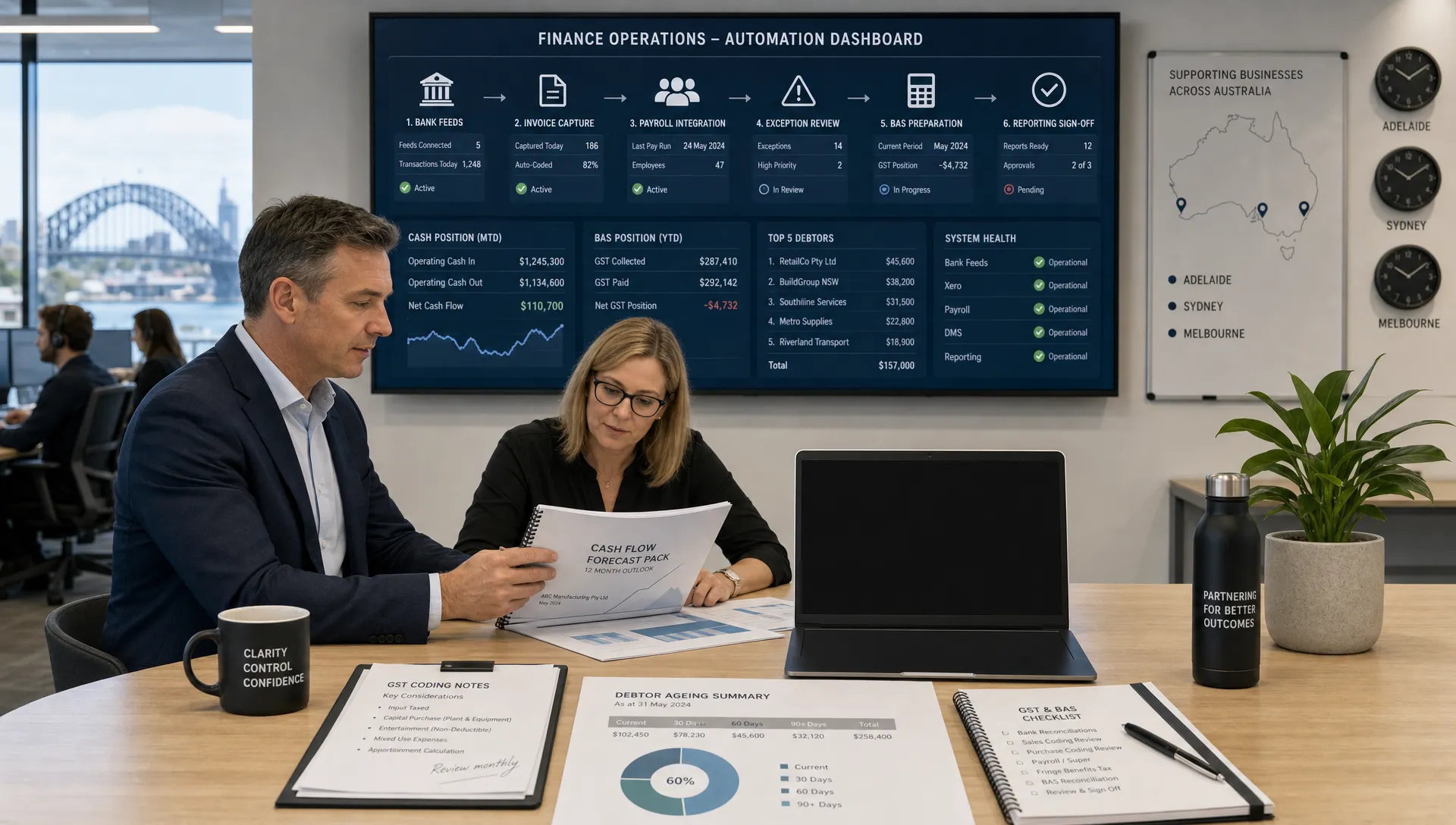
For Australian companies, automated accounting support is no longer a back-office efficiency project. It is a financial control system, a compliance safeguard and a strategic advisory platform. When implemented properly, automation gives directors faster access to accurate data, reduces avoidable tax and reporting risk, and frees finance teams to focus on growth rather than transaction processing.
We see this shift most clearly in companies that have outgrown spreadsheet-based bookkeeping, disconnected payroll systems or reactive BAS preparation. The issue is rarely effort. It is visibility. Directors need to know what the numbers mean while there is still time to act, not weeks after month-end or after the ATO has raised a query.
That is where automated accounting support delivers its strongest value. It does not replace professional judgement. It strengthens it with cleaner data, faster processing and real-time financial insight.
What automated accounting support actually means
Automated accounting support combines cloud accounting platforms, secure bank feeds, invoice capture, approval workflows, payroll integrations, AI-assisted transaction coding, exception detection and structured management reporting. In a company environment, it should also include human review, governance controls and tax advisory oversight.
For directors comparing accounting services for companies, automation should not be assessed only by whether it reduces bookkeeping time. The more important question is whether it improves the quality, timeliness and reliability of financial information used for decisions.
A well-designed automated accounting workflow should help companies:
- Capture transactions consistently and reduce manual re-entry.
- Reconcile bank, credit card and loan accounts more frequently.
- Identify unusual transactions, duplicate invoices or GST coding issues earlier.
- Improve BAS, payroll, superannuation and FBT data quality.
- Produce management reports that support pricing, hiring, funding and expansion decisions.
If your current finance function only produces numbers for tax lodgement, it is underutilised. Modern systems should create a foundation for strategic advisory, board-level reporting and corporate growth. We explored this broader expectation in our guide to modern accounting services for Australian businesses.
The main gains companies can expect
Automation changes the rhythm of finance. Instead of a delayed, compliance-led cycle, companies can move towards a near real-time model where directors and managers see financial issues as they emerge.
| Finance area | Traditional approach | Automated support | Strategic gain |
|---|---|---|---|
| Bookkeeping | Manual data entry and periodic review | Bank feeds, rules, invoice capture and AI-assisted coding | Faster, cleaner transaction data |
| BAS and GST | Quarterly scramble to verify figures | Ongoing GST code checks and reconciliations | Lower risk of errors and late adjustments |
| Payroll | Separate systems and manual checks | Integrated payroll, STP data and superannuation reporting support | Stronger wage, PAYG and super controls |
| Reporting | Historical profit and loss after month-end | Timely dashboards and management reports | Better decisions on cash flow, margins and growth |
| Advisory | Reactive advice after problems appear | Real-time exception alerts and forecasting | Earlier intervention and stronger planning |
The benefit is not simply speed. It is confidence. Directors can make decisions using information that is more complete, more current and easier to interrogate.
Stronger accuracy and fewer compliance surprises
Australian companies operate in a demanding compliance environment. GST, BAS, PAYG withholding, superannuation guarantee, FBT, payroll tax and income tax all depend on accurate source data. If coding errors, unreconciled accounts or missing invoices are not identified early, they can create costly clean-up work at year-end.
The ATO requires businesses to keep records that correctly explain their transactions and generally retain them for five years. Its record-keeping guidance makes clear that records must be accessible and sufficient to support tax reporting positions.
Automated support improves compliance by standardising how financial data is captured and reviewed. For example, recurring supplier invoices can be coded consistently, bank transactions can be matched more frequently, and exception reports can flag transactions that do not fit expected rules. This is especially valuable for companies with multiple cost centres, project sites, directors, cards, entities or locations.
However, automation should not be treated as a substitute for tax expertise. GST classification, FBT exposure, Division 7A matters, director loan accounts, capital versus revenue treatment and cross-entity transactions still require professional judgement. Our role is to combine automation with experienced review so that the system accelerates compliance without weakening control.
Faster reporting and more useful decision cycles
Delayed reporting is one of the hidden costs in company finance. If management accounts arrive too late, directors may miss opportunities to adjust pricing, manage labour costs, chase debtors, negotiate supplier terms or delay non-essential expenditure.
Automated accounting workflows allow companies to shorten the time between transaction, reconciliation and reporting. That gives management more timely insight into revenue, gross margin, operating expenses, debtors, creditors, tax liabilities and working capital.
The result is a stronger decision cycle. Directors can ask better questions, such as whether a business unit is generating enough margin, whether cash receipts are slowing, whether stock levels are tying up capital, or whether a new contract is profitable after payroll, materials, subcontractors and overheads are properly allocated.
This is where accounting becomes a strategic function. We have written separately about how a business services accountant supports better decisions, and automation strengthens that advisory relationship by giving us more reliable data to analyse.
Better cash-flow visibility and working capital control
Profit does not protect a company from cash-flow pressure. A profitable company can still struggle if debtors pay late, GST liabilities are underestimated, PAYG instalments are not planned, inventory absorbs too much cash, or directors draw funds without understanding tax consequences.
Automated accounting support helps by making cash-flow drivers more visible. Debtor ageing, creditor commitments, upcoming BAS payments, payroll obligations, superannuation liabilities and loan repayments can be monitored in one structured reporting environment.
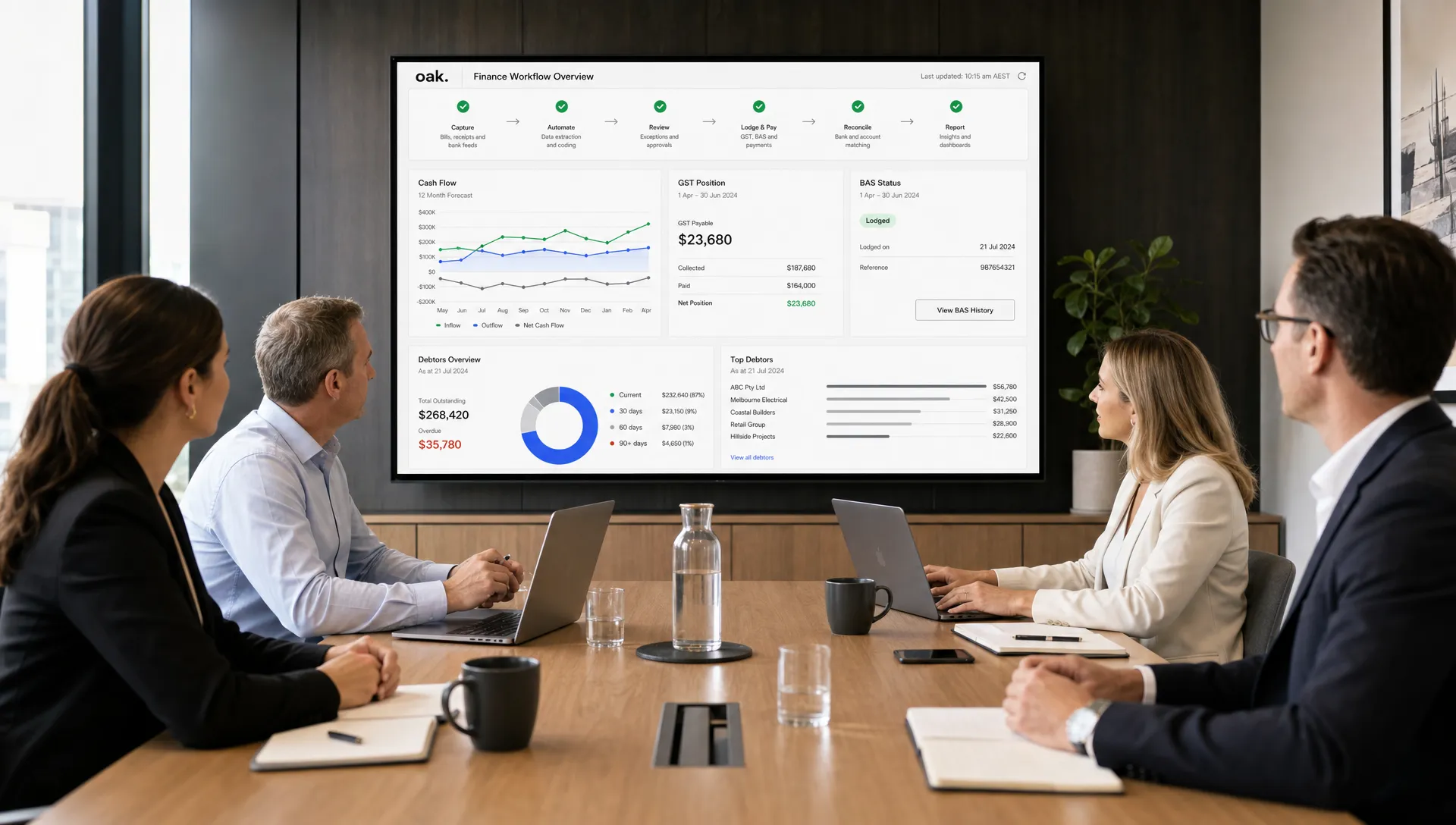
The most useful cash-flow reporting is forward-looking. It does not only show the bank balance today. It projects what the company may need to pay over the next month, quarter and financial year. That gives directors time to manage collections, negotiate terms, plan tax payments, review finance options or adjust spending before pressure becomes urgent.
For growing companies, this visibility is critical. Expansion often increases working capital demands before profits are fully realised. Automation gives our advisory team the data needed to model scenarios and support decisions around hiring, equipment purchases, new premises, acquisitions or interstate growth.
Stronger payroll, superannuation and director governance
Payroll is one of the most sensitive areas in company accounting. Errors affect employees, cash flow, PAYG withholding, superannuation guarantee and reporting to the ATO through Single Touch Payroll. Automated payroll integrations can reduce duplicate handling and improve consistency, but they still need proper setup and review.
For companies with employees across Adelaide, Sydney, Melbourne or other Australian locations, payroll data also needs to be segmented in a way that supports management reporting and state-based obligations where relevant. Payroll tax, workers compensation and industry-specific reporting may differ across jurisdictions, so the accounting system must be designed with compliance and analysis in mind.
Directors also have governance responsibilities. ASIC notes that companies must keep written financial records that correctly record and explain transactions and financial position. Its financial records guidance reinforces the importance of records that allow true and fair financial statements to be prepared when required.
Automation supports governance by improving audit trails, approval workflows and segregation of duties. A company can reduce the risk of unauthorised payments, missing documentation or unreviewed adjustments when digital approvals and system permissions are structured properly.
More time for strategic advisory and corporate growth
The greatest gain from automated accounting support is not that routine tasks become faster. It is that professional time is redirected towards higher-value analysis.
When our team is not spending unnecessary hours correcting basic data issues, we can focus on matters that materially affect company performance. These include tax planning, margin analysis, cash-flow forecasting, group structuring, succession planning, funding readiness, business acquisition analysis and Virtual CFO support.
For example, a company preparing for finance or investment needs reliable management accounts, clean balance sheet reconciliations and credible forecasts. A company considering expansion into another state needs visibility over payroll, GST, fixed costs and tax obligations. A company planning an exit needs financial records that withstand due diligence.
Automation provides the operating data. Strategic advisory converts that data into commercial action.
Where automation needs human control
AI-driven accounting processes are powerful, but they are not infallible. A system can learn from historical coding patterns, but historical patterns may be wrong. A platform can flag exceptions, but it cannot always interpret commercial context. A dashboard can display a margin trend, but it cannot determine whether that trend reflects pricing pressure, project leakage, stock shrinkage or poor cost allocation without professional analysis.
That is why we design automated workflows with review points. The goal is not to remove accountants from the process. The goal is to remove repetitive manual handling so that experienced accountants can spend more time on judgement, risk assessment and planning.
Key areas that should remain under professional supervision include:
- GST treatment for mixed supplies, property transactions or complex arrangements.
- FBT exposure for vehicles, entertainment, benefits and employee arrangements.
- Director loans, private use adjustments and Division 7A considerations.
- SMSF, trust, company and related-party transactions.
- Complex asset purchases, depreciation, capital gains and tax structuring.
- Audit queries, ATO correspondence and voluntary disclosure strategy.
In practice, the best model is human-led automation. Technology handles speed and pattern recognition. Accountants handle interpretation, compliance risk and strategy.
How companies should implement automated accounting support
A successful automation project starts with process design, not software selection. Many companies already have cloud tools, but still lack clean reporting because their chart of accounts, approval workflows, payroll categories, GST settings or management reporting structure were not designed strategically.
We recommend a staged approach.
| Implementation stage | What we assess | Why it matters |
|---|---|---|
| Diagnostic review | Current systems, reconciliations, reporting delays and compliance pain points | Identifies where automation will create the highest return |
| Data structure | Chart of accounts, cost centres, tracking categories and entity structure | Ensures reports support management decisions, not only tax lodgement |
| Workflow design | Invoices, approvals, bank feeds, payroll, expense capture and document storage | Reduces manual handling and improves accountability |
| Control framework | User permissions, review checkpoints, exception reports and audit trails | Protects directors and strengthens governance |
| Advisory rhythm | Monthly or quarterly reporting, forecasts and tax planning reviews | Converts automation into strategic action |
The companies that gain most are those that treat automation as a finance transformation project. It should be connected to governance, reporting, tax planning and growth strategy from the beginning.
Who benefits most from automated accounting support?
Automated support is valuable for many company types, but the return is strongest where volume, complexity or growth pressure is increasing. We often see strong outcomes for professional services firms, construction and trades businesses, e-commerce companies, property groups, medical and allied health practices, hospitality groups, logistics operators, technology companies and multi-entity family businesses.
It is also highly relevant for companies preparing for external finance, acquisitions, succession, restructuring or expansion. In these situations, directors need financial information that is timely, defensible and commercially meaningful.
High-net-worth individuals with company, trust, SMSF and investment structures can also benefit from integrated reporting. Automation can help consolidate data flows, but advisory oversight remains essential to manage tax, asset protection, estate planning and compliance implications.
Next steps for companies considering automation
Before adopting new accounting technology, directors should define the outcome they need. Faster bookkeeping is useful, but it is not the full objective. The real objective is better financial control, stronger compliance and clearer decision-making.
Practical next steps include:
- Review where your finance team loses time each month.
- Identify recurring BAS, GST, payroll, superannuation or reporting issues.
- Map the reports directors actually need to make decisions.
- Check whether your chart of accounts supports margin and cost analysis.
- Assess whether approvals, permissions and audit trails are strong enough.
- Decide which advisory questions your accounting data should answer.
Our team can help companies across Australia assess their current finance workflow, identify automation opportunities and build reporting systems that support growth. We provide integrated support across Adelaide, Sydney and Melbourne, with the ability to align accounting, tax, compliance and Virtual CFO advice under one coordinated model. Our broader growth approach is outlined in our article on how Perfect Accounting and Tax Services supports business growth.
Frequently Asked Questions
What is automated accounting support for Australian companies? Automated accounting support uses cloud systems, AI-assisted coding, bank feeds, document capture, payroll integrations and structured reporting to reduce manual work and improve financial visibility. For Australian companies, it should also include BAS, GST, payroll, superannuation, FBT and income tax oversight by qualified professionals.
Does automation replace an accountant? No. Automation improves data capture, reconciliation and reporting speed, but it does not replace professional judgement. Tax planning, structuring, FBT, Division 7A, related-party transactions, ATO matters and growth strategy still require experienced accounting and advisory input.
How does automated accounting improve BAS and GST compliance? Automation can help standardise GST coding, reconcile transactions more frequently, attach source documents and flag exceptions before BAS lodgement. This reduces the risk of last-minute corrections and gives advisers cleaner data to review.
Is automated accounting suitable for multi-entity or interstate companies? Yes, provided the system is designed properly. Multi-entity groups and companies operating across Adelaide, Sydney, Melbourne or other Australian locations need careful setup of tracking categories, payroll data, approvals and reporting structures to support both compliance and management analysis.
What should directors review before implementing accounting automation? Directors should review their current reporting delays, reconciliation quality, payroll processes, approval controls, GST settings, chart of accounts and advisory needs. Automation works best when it is aligned with governance, tax planning and commercial decision-making.
Speak with us about automated accounting workflows
Automated accounting support gives companies more than efficiency. It creates the financial clarity needed to manage compliance, protect cash flow and make stronger strategic decisions.
At Perfect Accounting & Tax Services, we combine 25 years of professional experience with AI-driven automation, advanced tax planning, corporate accounting and Virtual CFO advisory. We support companies and directors across Australia, including integrated service capabilities in Adelaide, Sydney and Melbourne.
If your company is ready to move from reactive bookkeeping to real-time financial control, contact our team for a consultation. We can review your current accounting workflow, identify automation opportunities and design a finance function that supports compliance, visibility and corporate growth.